


We're starting with real sequences today, you'll get a new sequence every time and we'll always be running them in parts, starting with a small part and then adding more&more obstacles, just as you can see in the video - reward where I rewarded and then start from 1 again, meaning that you'll always be doing the whole sequence only on a 4th try or so. Whole sequences will be pretty long, to get the flow, but do NOT run a whole sequence again and again - you can run little parts several times, but the whole sequence only once or twice. Always run it without the dog first and only when you really know it, try with the dog. After every try, PLAY, give a dog a break to rehearse the next sequence on your own and only then try again.
Don't keep running the same sequence for 2 weeks!!! You can either think of another sequence on your own or keep working on multi-wraps and sends (from lesson 1 and 2). Also, don't forget to keep working on weaves and contacts, we'll get back to that later!

And Bi on the same sequence to show how things should look like on a low and then higher height:
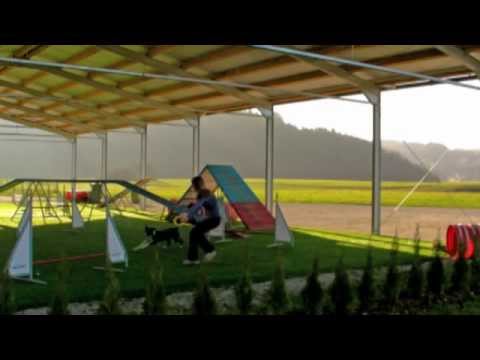
1. introducing straight lines: after all the cik&cap work, it's time to introduce some straight lines and extension jumping too. Set a straight line of 2 or 3 jumps between two tunnels (or simply use one if you don't have two), start with some cik/cap to tunnel, cik/cap to tunnel, then straight over the first jump to cik/cap on a second jump back to tunnel, then two straight jumps to cik/cap on a third one, cik/cap again on a next jump etc. - just think of something, putting more and more straight jumps in between one and another cik/cap. See a video and again another example here:

2. sequencing: start with cik on 1, run in for a front cross between 2 and 3, ask for cap on 2 from the landing side, RUN for cik on 5 (extension jumping on 4), another cap on 6 and finishing with cik on 8, rewarding in the direction of 9.

3. bang the see-saw game: if you did the "closing drawers and doors" trick, then you're all ready for this new game. If you don't have a see-saw, you can use a small plank with something underneath so that it moves when the dog pushes it with front legs. If you have a see-saw, either lower it almost to the ground or support it so that one end is 10 to 15 cm (4 to 6 inches) off the ground and have them push it down with front feet - you can then raise it somewhat more off the ground. Do not promote 4 feet, 2 feet is better to teach them to push. Jackpot for most powerful pushes and eventually stop rewarding the gentle touches. Reward away from the see-saw, you want a push&go (I'm not doing very good job on that in the video, I forgot to bring better treats for that - a toy would actually be even better). ONLY work on this part (step 1 and 2) for next 2 weeks (no 4 feet yet!) - I included next steps in the video just to give you an idea what's the plan 🙂
I'll be answering your comments till Friday 29th. Then I'm leaving for EO and have the camp after that, so we'll be on break till 15th August so that everybody can catch up AND you can practice cik&cap some more. We're introducing straight lines too today, but if you only started with cik&cap when the class started, you still need to do quite some work on that anyway - especially exercises 1 of lesson 1 and 2! You can also keep adding height... So, plenty of work for everybody! The second week of this lesson will be from 15-21st August, with no video commenting in between. I like those breaks as they take some pressure off and I can always see a huge progress after the break!


Hi. Here are some more multiwraps 😉 …and our first try with the first course. However I don’t think he is ready for kit/kat at full speed yet. Obstacle no. 1 is fine, but nr. 4 is way to wide? maybe I should try som more simple sends with kit/kat? more like the course from last time, and then adding some multiwraps? However I think he is quite narrow to the wing when we do more stationary multiwraps, or?
I don’t have a see saw at home, but I’ve postet an old video (2 months ago) to show you his behavior:
Yeap, his see-saw is fine, you can focus on cik&cap instead. Those are good also on a wings now, but yes, not yet when coming from a straight line, so for now, I would only do cik/cap to tunnel, back to cik/cap and similar. You can also try the other sequence I posted, but this one is extra hard for him as there is so much speed involved.
For multi-wraps, you can already set a really low bar. For sequences, I would first try it with no bars and if he is tight enough, you can try with bars too.
Hi… Bad news again: Kaoz has been operated again because of a very significant allergic reaction to the stitches used at the castration -- so we have 10 days with a plastic-screen ahead of us again 🙁
I’ve posted a video from our training the day before the operation (still no bars, but I will introduce bars when we are fit to train again):
Good luck at EO 😉
Whoops -- I’ve posted an old video. The new one is posted below:
Sorry to read about Koaz, hope he will get better soon! 🙁
Us too!
Thanks. We are ready to train again. This period went much faster than the last one, because the pain was minimal. Happy dog again 😉
HELP Please! I’m very frustrated with our training, and it all seems to come from one problem: barknocking. I hate this state of mind, because I want the agility training to be just fun. My first question relates to the barknocking: how should I react when Kaoz knocks a bar? In the video I try to ignore him for some seconds or to down him. Neverthless he seems to not care at all, as long as he can have another try 🙁 How can I tell him that it isn’t okay to knock the bars? Of course there will be situations where my handling forces him to knock the bar -- but just not in this case (I think). I’m very frustrated with this problem as I think it keeps us away from training real handling, because I have to correct each knocked bar -- and just isn’t the same with no bars and just wings.
Our other problem comes with speed. I think he is quite tight on the multiwraps when we are stationary, but when he gets the chance to accelerate he doesn’t slow down to wrap around the wing -- but just make a wide circle. How can build speed without widening the wraps? To me it seems that he is not even trying to be narrow when he is in great speed. Unfortunately I don’t have his speedy “wraps” with no bar on video, but I can tell he is just as wide with no bar ;-(
Do you have any suggestions for special exercises that will make him think more carefully while jumping? (lowering the frequency of knocked bars?). We have done quite many jumping exercises (from Susan Salo dvd’s ect.).
And do you have any suggestion for special exercises adressing the wide multiwraps when speed comes along????
From Charlotte
I think that on most tries, he is actually making a bar fall by touching a wing, not a bar. Can you check that in slow motion? I never saw jumps with so short legs, that definitely makes them fall very easily and I’m not sure if you have to train for that… I mean, do you see such light, short-legged jumps in trials too? Those that we see here are all partly metal or have much longer legs, so they don’t fall that easily, so maybe you’re training for something you don’t even need to? Can you fix wings a little bit more and then only redo when he is hitting the bar -- or the wing, but harder as that?
As for speed coming into the turn, you need to add it more gradually. Do it on one jump only first, starting him further and further away. Slowly, start adding your speed too, run more&more with him. When that goes well, you can do two jumps (figure 8 from lesson 1), maybe first closer together to not allow too much speed and then spreading them further and further apart. Then try a tunnel to the wrap back to the tunnel. Then make it look more like a sequence, like in lesson 2. Lesson 3 sequence is too much for now, you need to go slower with him as he already knows agility and thinks it’s about going FAST -- in whichever direction 🙂 So it will take a while I think.
I do think you are quite right about him hitting the wings -- about 50% of the knockdowns is caused to the touch of wing (watched in slowmotion). I’ll try to think of a way to make the wings more stabile.
Only one question left for now: how can I best tell him it is not acceptable to hit the bar when he does so? (he doesn’t quite seems to understand).
I mark it with “ups” as I see them touching it, but still, for Bi who is very excited and not touch sensitive at all, it took very long before she got it and started to do SOME effort to keep the bars up. Things on bars helped a lot, especially if in strong colours, I have orange buckets that I hang on bars and those really help to get her attention on bars.
Here we go with the RC on the carpet. Can someone see his hind legs? I must be blind because I cannot see them…
Silvia what do you think about? I do not have clue what I am doing as he is so fast to see something there…
Sorry for the funny noises in the video but it is the slow motion…
And here comes our fist session with the sea saw game…cool!
How cool is that?! 🙂 He would do anything for that ball!! What a fun little guy he is!
Brilliant! 🙂
Of course I can see his hind feet 🙂 They’re together in the first part of the video, but there, he is not focusing ahead because your throws are too late and he is looking back for the ball. You need to throw first and then release, not the other way around. In the second part, I think hind feet are separated, but I can’t see well from that camera angle. I need to see it from side, not from in front. No problems with the see-saw!
Hi Silvia,
I’m having Matilda work on taking jumps with collection and extension. We’re not running your course yet. This time I held the toy in my hand. Matilda turned to look at me a few times. She was very slow at the beginning but picked up some speed. I did the same thing again with the toy in my pocket. Matilda did a better job focusing ahead. I’ll post that next. How is she doing?
Liza
Here the toy is in my pocket. Matilda has better focus. When I shot the first video it was fairly hot. Here, it was evening, and cooler. Now I’ll work on running your course.
Liza
Oh, you don’t need to run it as I numbered, it was just to give you an idea what this exercise is about. And yes, work with a toy in a pocket and when it’s not too hot , but maybe add jumps even more gradually as she is still not focusing ahead as much as I would wish for… She still keeps checking back with you. Keep working on one jump and one tunnel sends (lesson 1) -- if you could send more to the tunnel, you could be further along the line and have her chase you more -- and run faster as a consequence.
Hi there Silvia and class mates. I have videoed nothing yet , but i just have to let you know you i have convinced 1 more to join Running Contacts 2 and this makes it now better for me to transfer to the next course as my equipment is still in pieces so i think it would be better to transfer. It is my good friend and training partner that has watched me so far and eventually given in!!!!!!!!!!!!!! Silvia you know her well Noelene Pretorious who was in the team that won 2 years team for SA, at world champs. And the next thing is she is now convinced too to teach Tip and Tuck as we trained a short bit today and she can see the extension and collection with Spy ( which we have been working on since i bought your DVD’s and in puppy class ) Can i ask please to keep Noelene a place as a participant and for me to transfer please as a participant. I would like to know if i will still be able to access the RC 1 just to read the comments and learn but i will not post questions and videos, please? I am so far behind but in this break i still want to get to watch the videos. thanks kindly, All the very best at the EO. We have 4 ladies and 5 dogs competing from SA.
Well, thank you for promoting the classes by doing such a great job with Spy! 🙂
Thank you
Hi Silvia -- good luck at EO!
Fab -- some catch-up time. Our week 2 homework is done
but I have to say it was rather a challenge given that we have not had many cik/cak sessions. My dog turns well but does not really get the seeking bit yet. She is also tuning out when asked to do more than 3 obstacles in a row, but that is fine because it is a very new thing for here and I’m sure it wil go away fast. I will post that video soon.
I have one question before you go and sorry I don’t have time to add video of it just now. But basically -- I have started the running contact work. On the flat plank I decided that I want the dog to touch 2 feet in the lower half of the contact (given my dogs are very small). This was fine on the flat.
With the plank raised a few cm, there are only occassional hits (say a third of tries). When its good its great but usually they touch just outside the lower half. Do you think this is too strict criteria or do they just not know the task yet? I don’t want to use the entire contact area as the acceptable zone, because with tiny feet if they touch the upper edge of the contact it is VERY hard to see that and call it correctly. Maybe I should change my criteria to lower two-thirds of the contact zone? What do you recommend?
I meant to say that Sen hits the lower half most times, the larger dog 1/3 of the time
Yeap, keep working on lesson 1 to get better obstacle focus, it’s a difficult one for small dogs, so it takes some work, but it’s well worth it!
At this stage of training RC, placement of feet should not be your major concern: the form of running should be. You can jackpot the best hits, but for me, the best hits are in the middle, not as low as you are going for as actually, most judges don’t see the touches at the very end at all (they already stop looking). But yes, at this stage, the dog has no clue what it is about 🙂 -- and the first thing they should learn that it’s about running FAST, focusing forward, NOT worrying about WHERE to hit!!! Feet placement come into the picture much later.
Hello Silvia,
Here is a quick cik/cap training video from last few days and we tried sequence2 few times.
I need to catch up with contact, weave, and sea saw during the holiday, hopefully we are doing okay with cik/cap.
Figure 8: I did far out distance jumps for figure 8 but it became wider turns so I decreased distance between jumps for this day. hmm
Running to tunnel: I realized Niah actually runs at full speed in to straight tunnel! so I have included tunnel and go-go game before the run..but still less drive for curved one.
*I made mistakes with tunnel entry so some commands are not making sense…and few mistakes on cue! we will try again but we both had a fun 🙂 GOOD LUCK with EO! Looking forward to watch La and Bu’s run!
Yeap, great on multi-wraps, somewhat wider on figure 8s… Try adding distance/speed gradually and redo the wide ones by asking for some multi-wraps. You can practise with straight tunnel for now and then slowly curve it again. No problems with the sequence other than yes, with that tunnel entry, that wouldn’t really be cap. Also, you are somewhat late giving your verbal cues -- works for now as bars are so low, but it’s good to learn good habits already now 🙂 Happy training!
Thank you for the comment Silvia!
it is very helpful tips and I know exactly what do I need to practice during the next 2 weeks 🙂
Thank you again
Emi&Niah
Hi Silvia,
Good luck at EO! Perfect timing as Emily & I are heading out for a camping, hiking, backpacking adventure and we’re not back until the 15th and I was so worried about how far behind we would get. No we can just relax and enjoy ourselves:)
Here’s a video of our teeter banging, a few go’s at the straight lines and some multi-wraps. First of all, I can see a few things, one I really seem to over handle her turns (no doubt left over from running my last big launching boy who needed turn signals about a mile ahead of time) which makes her look at me rather then the jump. I think we’ll work out that with practice. I also moved her jumps up to 16″ for one session, I’ll admit that I know she is not quite ready for the height of the jump to turn easily but I couldn’t keep up with her at all on the straight lines and so she was just turning back to me and not able to go on to the next jump. Now that she’s figuring out how to drive ahead to the next obstacle on her own a little better I’m going to go back down for the next week and work more on getting the turns better. That’s good news, that she started out running me:) And you can see I have a tug, so she’s driving not just for the ball. (I think the biggest change was doing a few more obstacles with the dog walk, now she thinks anything we do that relates to the dog walk is more fun)
Hey Dawn-love where you placed your camera! That will help me get a better video!
training alone presents some filming challenges! The down side are all the butt shots since the camera is right at that level:) Hopefully everyone is mesmerized by Emily’s adorableness enough that they don’t notice my large bottom…
Yes, obstacle focus is not quite there yet, so try to play lots of send to a wrap (and tunnel!) games (lesson 1). Also, you can add jumps to that straight line slower, like only using first two jumps after the tunnel for now, to keep it more fluent and with less checking back. It’s just a question of few more trainings, so I wouldn’t rush it and just give her more time and not higher jumps for now.
Got it! Will keep at it. She does pretty good with the sends but only if I am standing somewhat still, she still gets distracted by my movement.
So glad we are having a little break! We can catch up with a few things. Also, I am starting a new project/challenge with Tibby. I call it the 100 Jumps Challenge. I want to take Tibby and our little mini jump to 100 new places before the end of August. Do some tricks and have her jump the jump a couple times.
We had a lesson yesterday and it didn’t go very well. The agility equipment was moved to the other side of the field, close to a pasture with sheep. Tibby was very interested in the sheep and then she was distracted by every noise -- cows mooing, pheasants calling in the trees, sheep baaing.
Our instructor had us doing 4 jumps- 2 straight and then a push to the backside of the 3rd jump, then a FC and then straight to a 4th jump. The first time Tibby did fine, but I messed up the FC. The 2nd time we did it perfectly 🙂 So proud of Tibby! But then we moved to the tunnel -- to have Tibby go through it a couple times, but she refused and ran off to the other side of the field, where the equipment used to be. She did some jumps on the far side of the field (by herself) and then ran around the corner of my instructor’s house. She wasn’t zooming -- she was just trotting around by herself.
Finally we got her to come back, after I hid in the garage and she came looking for me. Then we went back to try the jumps again and she ran away again. After that she had to be on leash.
She was very happy to do tricks and eat treats the whole time. She also would take a jump if we walked by one (and then look for her treat!), but if I asked her to take a jump she would refuse and go around.
So that is why we are doing the 100 Jumps Challenge. To get her used to working in different places and around distractions. It can’t hurt to try! 🙂
In the video
I’m not running very much when we were playing around with the jumps outside -- I have a horrible cold -- I hate summer colds!
Love the 100 jump challenge! I’m joining you with the 30 weave pole challenge-I am taking my weaves 30 different places in the next month! Thanks for the fun spin on the the idea of going other places with equipment.
Yay! It’s a good way to get out a do stuff other places. I like to have a goal, because otherwise I ‘forget’ to do it 🙂
So far 3 down 97 more to go……
You have my sympathy. My husband was kind enough to bring a summer cold home about a month ago. Needless to say I caught it too. It was nasty and sapped any energy I had. Hope you are soon feeling better.
Maureen
I starting to think I should change it to 30 Jumps -- 100 is a BIG number. It’s hard when the weather won’t cooperate. Today we woke up to tornado sirens and there are still big storms moving through, so no outdoor jumps for us.
Just thought you might like to see this video. It was one of our jump challenges with a twist! Two dogs for the price of one!
My Mom was dog sitting a friend’s dog this weekend. Tibby has never been allowed to be around this dog before, because her owners said she was agressive with other dogs. Well, this video shows that you should always give a dog a 2nd chance. I think she might have some problems when she is on leash -- from some of the stories they have told us- but she didn’t have any problems with Tibby.
It was so fun to play with a BC type dog. WOW! Fastest sits I’ve ever seen. I hope Tibby was paying attention LOL! 🙂
When working with the see-saw, feed her away from it so that she can then push it again. But go very slowly with it, she is unsure about it. have fun with your 100 jumps challenge! 🙂 Also, don’t forget on handling too! Try to practice without obstacle sometimes, running with her on your left side, then front crossing so that she is running on your right side, then shoulder pull and have her stay on your right side, then front cross again etc. I think for now, the best is to practise it without jumps, so that you can really focus on your moves without worrying about jumps.
Here is a clip of us doing the first exercise, or rather trying to. It is MUCH harder with a very big fast dog than with my small, slower dogs! I made a lot of timing mistakes with my “tick”. But I just fed him his dinner so I won’t be able to redo it for awhile and I wanted to post. He seems to be able to turn tightly when I cue it correctly at this height. Should I go higher? We had fun but I will try again tomorrow to get my timing better.
Also, somehow I got some weird music on this clip-I tried to mute it but if it didn’t work, my apologies!
Ok some weird error message-I’ll try one more time.