


Your last homework already! Two more weeks left to catch up and then with October 3rd, this class is finished. If you want to keep working on Foundation stuff in a class form, you can join October Foundation class (that is repeat of this class) for a reduced price. If you want to take things further, you're welcome to continue in Handling class that will start 31st of October, I'll open the registration soon. In Handling class, I'll be posting two different exercises for two different levels: the whole course for more experienced teams and shorter sections that will still be focusing on training to some degree for beginners.
1. sequence

Let's check your stays. I usually train them away from agility until they are 100% with toys flying, dogs running around, me moving etc. - and then just use them here and there also in agility: probably only for about 10% of sequences we run, to make sure I'm not given too many opportunities to ruin them 🙂 In this sequence, you need a stay. Position your dog at the good angle to be on a good line for 2nd jump, go to your position and start. Choose how you want to handle it.
2. front, rear and blind crosses: as there were some questions on the crosses, I included a video with different crosses on the same sequence. Normally, I first do front crosses only (as I only do collection sequences) + blind crosses on tunnels, then add rear crosses on flat and at tunnels, then blind crosses and then rear crosses on jumps. So try rear cross on a tunnel and on flat first and if that goes well, try it on a jump: see the video - just ignore the double tunnel, use a single tunnel of course, I just used whatever I already had in a set up. If you want (I'm not forcing anybody, I'm just including those as some participants were asking about them), you can try it with blind crosses too. Normally, I will choose the cross based on a situation: for collection, I will use a front cross OR, if I can't get there in time, rear cross at the jump. For extension, I will choose blind cross OR, if I can't get there, rear cross on flat. At trials, I do the most front crosses, then blinds and maybe one rear cross every 5 runs... Yeah, not big fan. But of course, it's important the dogs know rear cross too as sometimes it is the only option!


You could of course run those sequences with front crosses only, I showed it with rear and blind crosses only as by now, I think we mastered the front crosses already, so we can try some rears and blinds (if you want).
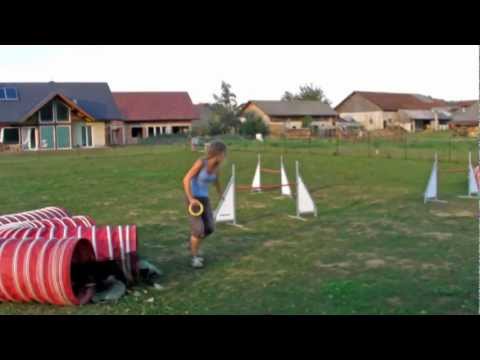
3. send in your contacts, see-saw, weaves and multi-wraps (on your current height) work again to check how it's going and to give you some suggestions on how to proceed after the class is finished.
Hope to see you in Handling Class!


Hi Silvia
Could you give us some tips for proceeding with see-saw? I would like to do handling class but our space is just not big enough. Might continue with next AF as we still have lots to do from lessons 5+6!
Sure, just post where you are now!
She has only done the slamming. I saw the video from L4 but I’m a bit confused -- how to apply it to my small miss who cannot jump up that high onto it.
My other dog does a 4-on end position in a down. This seems a better option when you have to do a very bouncy seesaw (I have seen toy dogs flipped over and knocked in their delicate places with 2on-2off when they cannot hold down the weight of the rebound bounce).
So, I know I first shape her to jump on and lie down at the end of the board, but how to move to the the getting on stage?
Should I prop up the getting-on side so that the end of the board (getting off end) is raised off the ground a little, lift her up onto the start of the board and let her run down to the end position? This way I can make it so the board only moves a little, and then gradually lower the getting-on side until she can get on there on her own, by which stage it will be almost a normal seesaw movement?
About the handling class, you have see the size of my area -- its about 10x12 m. I cannot set a full sequence in there -- the sequences from L4+5 only just fit. Would I be able to do handling class? I would have to break the sequences down into bits (which is not necessarily a bad thing for a beginning dog)
Yeap, 4on is definitely better for such a small dog! Fix the teeter close to the ground enough that she can jump from the side to the very end of it and do lots of rewarding there for letting her know that’s the place to be. Once she loves jumping on and knows on what place the rewards come, you can proceed as you described.
And yes, you would definitely need to improvize some for handling class and set it in smaller parts, but as you said, that’s not bad for a beginner dog anyway!
Should we be at full height at the end of this class before we go to handling class? I too am trying to decide what to do next.
No, of course not. It doesn’t matter on which height you work on your handling and also those who don’t do contacts or weaves yet are welcome to join, you can always skip those obstacles or replace them with a tunnel/jump. Meaning that it’s not necessary to have all the obstacles or enough space for a whole course, you can set it in little parts.
Thanks,
I wasn’t sure how important it is to do these exercises at full height. I will try to come up in height during the break. For now I am learning a lot by progressing through the lessons as a lower height.
Pour les francophones voici la traduction que j’ai pu faire de la leçon 6.
Ce n’est pas parfait, mais j’espère que vous comprendrez. Si jamais n’hésitez pas à poser des questions.
Juste pour information le japonais ou jeannette, c’est quand le chien change de côté dans notre dos (on le perd de vue à ce moment). Je sais qu’on le nome différemment selon les régions, c’est pourquoi j’ai tenu à vous l’expliquer.
Leçon 6
Déjà votre dernier devoir! Plus que 2 semaine, puis le 3 octobre, cette classe sera terminée. Si vous voulez continuer à travailler sur des trucs de fondation dans une classe, vous pouvez rejoindre la classe de fondation d’octobre (qui sera la répétition de cette classe) pour un prix réduit. Si vous voulez aller plus loin, vous êtes les bienvenus pour continuer dans la classe de Handling qui va commencer le 31 Octobre, je vais ouvrir l’enregistrement bientôt. Dans la handling classe, je donnerais deux exercices différents pour deux niveaux différents: le parcours entier pour des équipes plus expérimentées et de plus courtes séquences, qui seront toujours axées sur la formation, pour les débutants.
1. Séquence:
Voyons maintenant vos départs arrêtés. J’ai l’habitude d’entraîner les départs arrêter d’abord loin de l’agility, jusqu’à ce qu’ils soient sur à 100% avec des jouets volants, des chiens qui courent autour, que je puisse me déplacer etc -- puis je les introduit ici et là aussi en agility: je ne les utilise que dans environ 10% des séquences, pour m’assurer que je ne donne pas trop d’opportunités de les ruiner. Dans cette séquence, vous avez besoin de faire un départ arrêté. Placez votre chien dans le bon angle pour avoir une bonne ligne pour le 2ème saut, aller à votre position de départ et choisissez comment vous voulez faire cette séquence.
2. Pivots, coupés arrières et japonais (ou jeannette)
Japonais (ou jeannette): parce qu’il y avait des questions sur les différents pivots et croisés, j’ai inclus une vidéo avec les différente façon de procéder sur la même séquence. Normalement, je fait d’abord uniquement des pivots (car je ne fais que des séquences de collection) + des japonais (jeannette) sur des tunnels, puis j’ajoute des coupés arrière au sol et aux tunnels, puis des coupés arrière et des japonais (jeannette) sur les sauts. Donc, essayez en premier le coupé arrière sur un tunnel et sur le sol et si cela se passe bien, essayez-le sur un saut: voir la vidéo -- ignorer le tunnel double, et bien sure, utiliser qu’un seul tunnel, j’ai juste utilisé ce que j’avais déjà dans une mis en place. Si vous le souhaitez (je ne force personne, je l’inclus juste parce que certains participants m’ont posés des questions à ce sujet), vous pouvez l’essayer également avec des japonais (jeannette). Normalement, je choisi selon la situation: pour la collection, je vais utiliser un pivot ou, si je ne peux pas arriver à temps, j’utilise un coupé arrière au saut. Pour un saut en extension, je vais choisir un coupé arrière ou, si je ne peux pas arriver à temps, j’utilise un japonais (jeannette) au sol. En compétition, je fais le plus souvent des pivots, ensuite des japonais (jeannette) et peut-être un coupé arrière tous les 5 parcours … Oui, pas une très grande fan. Mais bien sûr, il est important que les chiens connaissent aussi le coupé arrière, car c’est parfois la seule option!
Bien sure, vous pouvez faire ces séquences en utilisant uniquement des pivots, je l’ai montré avec des coupés arrière et des japonais (jeanettes) uniquement maintenant, parce que je pense que nous maîtrisons les pivots, donc nous pouvons essayez quelques coupés arrière et japonais (jeanettes), (si vous le voulez).
3.
Envoyer votre travail sur les zones, la balançoire, le slalom et les cik/cap (à la hauteur actuelle), pour encore regarder comment ça va et pour vous donner des astuces sur comment procéder, une fois que la classe sera terminée.
J’espère vous voir dans la Handling classe!
To be honest, I didn’t had lot of time to take videos of our past lessons. We have a bad weather now, very cold and rainy. And I have done lots of agility seminar or competitions or other things.
I know It’s not an excuse ^_^.
Maybe the class was a little bit too fast for me. And my problem is that I have to take all obstacles by foot to the place I can do training, then I train for 5 minutes and I have to take all back. And I make 2 to 4, or more agility training per week. This includes training at the club, competition, seminar, etc… So when it’s sunny I prefer to go for a walk with my dogs. ^_^
But I have enjoyed this classe and to see each others experiences, and of course Silvia’s advices.
So, thank you a lot Silvia, for the time you spent for us and I hope I can join another class, but maybe only as auditor for this time.
Justine
Yes, it’s hard when you need to take obstacles somewhere to train, I know the problem as I used to live in apartment… -- it’s so much easier with a yard! Anyway, you can of course work on the exercises later on, when the weather permits it. Have fun!
Hi Silvia,
Could we have the final steps of the see-saw in a tiny video , please? 🙂
I won’t have much time until december but I’ll try to join the handling class because I love so much your approach.
Céline
Just check the video I first posted with the see-saw, the whole process is there. Handling class is not as time consuming as others, the most time consuming part is setting the sequence/course, but maybe you can do it together with somebody from your club.
you mean there are only 3 steps for the see saw?
step 1: low
step 2: high
step 3: 2on2off low and then high
step 4: we go through ?
cool !
Yeap, that’s it.
Hi Silvia, I played with the sequence this morning and was able to piece most of it together. I had trouble with 6-8. Nero comes out of the tight turn at 6 pretty slow, and then gets really wide for the easy run to jump 7. He ends up hitting the “around” at 8 simply because he’s so loopy on 7. The batteries on my camera are dead so I’m off to get some of those now to see if I can capture the moment. Anyways my problem is that he seems to mentally detach when he doesn’t have to focus on fun turns.
Nancy
I think I know what you’re talking about, I call it a “BC circle” -- instead of coming straight back to you, they tend to drift away on places where they can’t see the obvious next obstacle to focus on. Bi was a terrible drifter, that’s why I did that front-blind cross on 6, it tightens her up. I also did tons of calling to hand and rewarding her for catching me and taking a toy out of my hand as I run (about what you can see in a video). It helped a lot despite she sometimes still does it in some particular situations (where she sees a tunnel, but knows it’s not the next obstacle, can’t see the next obstacle and I can’t run much). It also happens more often when she is already tired or hot. So make sure he is fresh when you try it again and do lots of rewarding at various points from 6 to 7: first right after 6 and then further&further towards 7.
That’s a perfect diagnoses! It totally makes sense and of course in herding I am supposed to be encouraging him to drift away from his sheep to cause less tension. We’ll see what happens tomorrow on this with frequents rewards in places where he gets drifty.
Thanks, Nancy
Yeap, it’s mostly herding lines that do that. When not knowing exactly where to go next (nothing obvious right in front of them to drive to), they release that tension by drifting. A PyrShep would bark, a BC drifts 🙂
You wanted to check teeter and weaves. Thanks for your comments.
Looks good to me! I think his 2on2off is fast enough, I think you were complaining it’s not???
You are right. We went to a trial this weekend and saw my video of the run and was very proud of his contacts! Did a push to the back of a jump in another course (Snooker, we make up the course) to get a better angle at a serpentine and it went great! Very similar to Lesson #5 sequence. It was at full height which I had not practiced but it worked. So fun!
Wow, sounds great! So happy to hear you can already see the results!
So sorry, the last video was just a visual test. Can you delete it? I will post my hardest entry soon to get your input.
Hi everyone!
Today I have received our obstacles. Finaly I can practice with real equipment!
We are so behind. I am thinking about repeating this class.
I am sending our cik cap exercise, contacts and dog walk.
Azja was afraid of a dog walk in full height. Today I could change the height and she did this o.k.!
I have a question about contacts. I practiced with Azja RC and 2on2off. With plank 2on2off and RC were OK. But today when she was very happy about agility training and she has seen A-frame for the first time she had a lot of mistakes with 2on2off but her RC was O.K.!
I don’t know what should I choose. She is really crazy and I am afraid that she will have problems with 2on2off. Her „stay” generally is very good but when she is on agility field she doesn’t stay sometimes.
Congratulations on your obstacles! Very cool! But… For A-frame, you definitely don’t want 2on2off! Only train RC on A-frame and on DW, you can have both, but of course she will need more confidence for RC to be able to do it. Practise the stays on agility field a lot too -- but make sure you ALWAYS release her with a verbal, NOT your movement! Proffer her stays for your movement and for now, always be static when you release. I think she is releasing on your movement and that often gives you a tense, not solid stay. When working on one jump exercises, always use a jump approach from the side to practise the difficult stuff.
Could you help us with the teeter please? I’m not sure that I understand what we are supposed to do.
This was our our entire training session today -- I cut out the parts when Tibby was playing with her ball or I was adjusting the teeter. It was very windy today and something was squeaking outside in the wind. At first she couldn’t figure out what the noise was, so her bangs weren’t very strong. This was the first time I asked her to get ON the teeter.
Was I supposed to only let her bang from the side? Or only from the front? She weighs around 20 lbs/ 9kg, so I was planning on having her lay down. Right? She offers a bow, would that be OK too?
Yes, a bow is o.k., just try to make her come on it from the side now (you can block other approaches by standing next to her as you bring her sideways to the see-saw) and slowly make it higher again so that it moves more&more as she jumps on it.